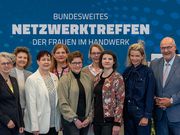
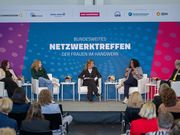
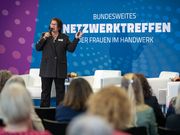
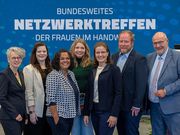
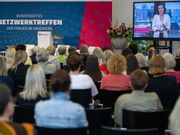
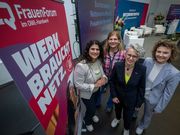
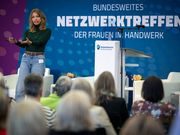
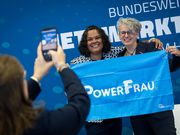
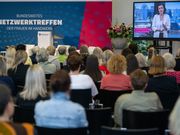
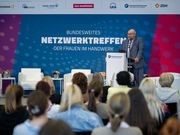
The "Nationwide Network Meeting of Women in Crafts" in Bielefeld sent a strong message: It was about greater visibility, role models and the importance of networks.
Women now make up around a third of the 5,6 million people employed in the skilled trades; almost one in four businesses is run by a woman, and in many other family businesses, women play a key role in management. And yet, even today, they are still viewed as oddities by many male colleagues, trainers, teachers, and especially customers.
"Isn't that too difficult for you?", "Can we speak to the boss?", "Can you manage that?", "Who will look after your children while you're at work?" – Almost every woman who works in a trade, runs a business, or is in training is familiar with these kinds of comments. Some swallow them down, others fight back – either way, these everyday forms of discrimination leave their mark. A new way of thinking about gender roles is needed, it was said in Bielefeld.
Peter Eul: "Let's shape the future of craftsmanship together."
"Women are not an add-on in the trades," emphasized Jessica Beitzel, a master funeral director from Dormagen (Hüsgen Funerals) . "They are part of its future. Not better, not worse – just different. And this difference is what makes transformation possible." The future of the trades, the speakers agreed, will not be determined solely by machinery, AI applications, or new building materials. "What good is the best technology if the attitude doesn't change?" asked Jessica Beitzel.
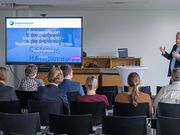
The first welcoming address was given by a man, namely Peter Eul , President of the East Westphalia-Lippe Chamber of Skilled Crafts. He emphasized that equality in the skilled trades concerns both women and men equally and that the meeting should foster a sense of community. While the focus of the day was on female perspectives, Eul added, "Let's shape the future of the skilled trades together." Eul also thanked the event's sponsors: IKK classic, Signal Iduna, and Commerzbank.
The goal is to have more women in leadership positions and in voluntary roles. The trades organization is prepared to go the extra mile to achieve this. One example cited is the chamber's new women's forum, where women from apprentices to business owners can network. In the Bielefeld chamber district alone, nearly 17 percent of all apprentices are female, 64 women recently passed their master craftsman's examination, and 7.296 female tradespeople run their own businesses.
"Network!"
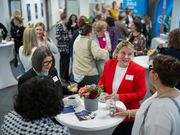
The keyword "networking" was a recurring theme throughout the event. Networking is a strength that has long been established in many male-dominated structures and that women in the trades should also utilize more: Whether in the "Women Entrepreneurs in Trades" or in WhatsApp groups: "Network," was a recurring message throughout the day.
Juana Bleker, State Chairwoman of the Association of Women Entrepreneurs in Crafts NRW , also called for this . The fact that the UFH network has existed for 50 years, making the achievements of women in crafts visible and empowering them, speaks for itself. It also demonstrates how strongly women in crafts are networked on an equal footing. Bleker emphasized: "We are a significant force in the crafts sector."
Video messages from Jörg Dittrich and Dorothee Bär
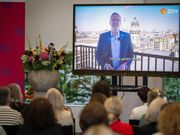
ZDH President Jörg Dittrich and Dorothee Bär , Federal Minister for Research, Technology and Space , addressed the guests via video message.
Jörg Dittrich, president of the German Confederation of Skilled Crafts (ZDH), pointed to the strained situation in the skilled trades: declining sales, dwindling order books, and vacancies for which too few skilled workers can be found. For precisely this reason, the skilled trades need more women to take over businesses and train skilled workers, as well as more women in honorary positions within skilled trades organizations. The ZDH president pledged to make the prospects for women in the skilled trades more visible and to "strengthen their hands so that they can contribute without hindrance."
Minister Dorothee Bär welcomed the idea of the nationwide networking event and its goal of increasing the visibility of women in skilled trades and dispelling stereotypes of them being a "male-doer." She congratulated those present on finding their way into skilled trades and serving as "doers" and role models for young women.
Dorothee Bär presented her ministry's high-tech agenda and highlighted the important topic of women's health research , for which her ministry now has its own dedicated department. Women in skilled trades often perform physically demanding work, are simultaneously underrepresented, and issues such as prevention and gender-sensitive medicine are frequently neglected. Her ministry promotes women's health research "across a broad spectrum." The goal is for the results to benefit all women, their families, their businesses, and society as a whole.
"The future doesn't need perfect women. It needs visible women."
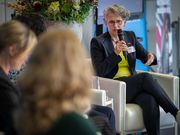
Jessica Beitzel, 37, is a master funeral director, mother of two, owner of Hüsgen Funeral Home – a company she took over – a family grief counselor, and teaches at a master craftsman school. For 21 years, she has accompanied people "in the worst moments of their lives," as she puts it. In these situations, no title, no facade matters anymore. "Then real words, real people, real encounters count." It is precisely this attitude, this sensitivity, that are strengths women bring to the trades – strengths that are simply absent from the old image of "the man with a machine on the construction site."
When she wanted to start her training as a funeral director at 16, her high school teacher strongly advised against it. "If you go into a trade, you'll never amount to anything." Jessica went anyway. At vocational school, 75 percent of the trainees were men; at the cemetery, she was the only woman, and at 16, the youngest. "I not only had to learn the technical skills, but also learn to assert myself—in a world that didn't even consider the possibility of a woman doing this job well." She became the chamber, state, and national champion, later a master craftswoman, and top of her class.
And yet she experiences the same scenes time and again: When she's at trade fairs with her husband and team, eyes automatically wander to the men first. A grieving family scrutinizes her from head to toe at their front door and asks: "You're going to explain to me how this works? Do you even know what it means to say goodbye?" "That's the moment," says Jessica Beitzel, "when we have to prove ourselves before we've even begun. When we're judged not on our performance, but on an image." These images, as the entire conference demonstrates, persist stubbornly – across all trades.
Jessica Beitzel has set up a children's play area in the attic of her funeral home so that she—and, if needed, her employees—can bring their children along. In an industry where pregnant women are no longer allowed to care for the deceased, she's creating new procedures to keep them involved in the business. "I believe I'm a better funeral director because I'm a mother. And a better mother because I'm a funeral director."
She also calls on all women in the trades to network. She herself is, for example, a member of the Commerzbank Businesswomen's Club , a nationwide network of female entrepreneurs.
"The wind has changed, the tone is becoming harsher"
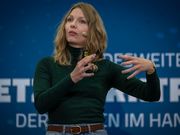
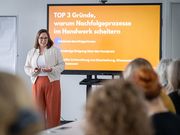
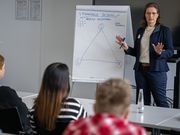
The extent to which the social climate is currently changing was outlined by business psychologist Lisa Schleker . She works in many sectors and sees the same thing everywhere: "The tide has turned. The tone has become harsher. Issues like equality, diversity, and sustainability are once again being questioned." The current polycrises are creating uncertainty. "And uncertain people tend to long for the good old days – with clear roles and clear visions."
This desire for simplicity is the breeding ground for the current backlash : equality is being relativized ("Haven't we achieved enough?"), diversity programs are being defamed, and "wokeness" is becoming a term of abuse. On social media and talk shows, complex structural problems are reduced to simplistic blame: "Women who pursue careers no longer take care of their children."
For Lisa Schleker, this is no proof that equality has failed. "Progress in equality is never linear," she says, referring to the history of the women's movement. Every wave of emancipation—voting rights, having one's own bank account, the right to work—has been followed by a counter-movement. "But it never completely goes back."
The current level of aggression is a sign of how effective visibility has become: "The louder we are, the louder the others become." She calls suggestive remarks on the construction site, condescending questions, and doubts about competence microaggressions – small pinpricks that, in total, wear one down.
It's a field of tension. Especially in the skilled trades, tradition clashes with innovation, creating constant friction. "Women are urgently needed, but the structures often don't yet align." Her message: "We will remain steadfast, even when the tide turns."




Write a comment